📖 Reading time: 9 min
Quick answer: For accuracy, read R. A. Nicholson’s complete translation (1925–1940), the scholarly standard, or Jawid Mojaddedi’s six-volume verse translation (Oxford World’s Classics). Alan Williams offers blank verse with the Persian text for Books One and Two. Coleman Barks’s popular books are free versions, not translations. To read the Persian too, use a bilingual Persian–English edition.
Who this is for: English readers choosing a Masnavi translation, students comparing versions, and learners who want the Persian beside the English.
There is no single “right” English Masnavi. Some translations aim at accuracy, some at poetry, and some are new poems inspired by Rumi. Knowing which is which saves you from reading someone else’s ideas under Rumi’s name.
This guide compares the main English versions of the Masnavi: who made them, when, how complete they are and what kind of reading they suit. It ends with how to choose, and why a bilingual edition is the best tool if you want to get close to Rumi’s own words.
Masnavi translations at a glance
| Translator | Published | Coverage | Style |
|---|---|---|---|
| R. A. Nicholson | 1925–1940 (Gibb Memorial Trust) | Complete, all six books, with Persian text and commentary | Prose; the scholarly reference |
| E. H. Whinfield | 1887 (Trübner) | Abridged selection | Older, readable abridgment |
| Jawid Mojaddedi | Oxford World’s Classics, Book One to Book Six (completed 2025) | Complete, all six books | Rhyming couplets |
| Alan Williams | Penguin Classics (Book One); Bloomsbury 2020 (Books One and Two with Persian) | Books One and Two so far | Blank verse |
| Coleman Barks | From 1984 onward (e.g. The Essential Rumi, 1995) | Selections from the Masnavi and the Divan | Free American versions, not translations |
R. A. Nicholson: the complete scholarly translation
Reynold A. Nicholson produced the first complete English translation of the Masnavi. The Gibb Memorial Trust published his eight-volume work between 1925 and 1940: the Persian text (volumes 1, 3 and 5), the English translation (volumes 2, 4 and 6) and a two-volume commentary (Gibb Memorial Trust). Dar al-Masnavi calls him “the first to translate the entire Masnavi into English” (Dar al-Masnavi).
Nicholson is precise and close to the Persian, which is why scholars and serious readers still use it. His English is old-fashioned, and it reads best as a guide to the meaning, ideally with the Persian beside it. Persian Bell’s six-volume Mathnawi pairs the full Persian text with Nicholson’s translation.
E. H. Whinfield: the Victorian abridgment
E. H. Whinfield published Masnavi i Ma’navi: The Spiritual Couplets, “translated and abridged”, in London in 1887 (National Library of Ireland catalogue). It selects passages from all six books and is easy to find in reprints. Use it for a first taste, but remember that it leaves out most of the poem.
Jawid Mojaddedi: the complete verse translation
Jawid Mojaddedi has translated all six books for Oxford World’s Classics in rhyming couplets, to echo the form of the original. Oxford describes Book One as “the first unabridged verse translation of Book One… for more than a hundred years” (OUP), and Book Six, published in 2025, as the volume that “completes Jawid Mojaddedi’s prize-winning translation” (OUP).
This is the best choice for readers who want the whole Masnavi as poetry in modern English, with notes, in a reliable translation.
Alan Williams: blank verse with the Persian
Alan Williams translated Book One as Spiritual Verses for Penguin Classics in blank verse (Penguin), and in 2020 began a new edition, The Masnavi of Rumi, with the Persian text facing the translation, starting with Books One and Two (British Institute of Persian Studies). It is readable and scholarly, and the facing Persian makes it useful for learners.
Coleman Barks: versions, not translations
Coleman Barks made Rumi a bestseller in the United States, but he does not read Persian. The Poetry Foundation describes him as “not a translator so much as an interpreter” (Poetry Foundation), and Dar al-Masnavi notes that his Masnavi versions are based on Nicholson’s English (Dar al-Masnavi). In his own words, he works “without much attention to historical context, nor much literal faithfulness to the original” (Dar al-Masnavi, quoting Barks).
His books are moving modern poems, and many readers first met Rumi through them. But they often drop Rumi’s Islamic references and add new meanings, so they are not a reliable guide to what Rumi wrote. Many of the quotes shared online come from them, as our guide to real and fake Rumi quotes explains.
Comparing translations of one line
Here is the first line of the Masnavi in Persian with Persian Bell’s literal translation. Compare it with the opening of any version you are considering.
بشنو این نی چون شکایت میکند
از جداییها حکایت میکندBeshno in ney chon shekayat mikonad / az jodayiha hekayat mikonad
“Listen to this reed, how it complains:
it is telling a tale of separations.”
A faithful translation keeps the three key ideas: listening, the reed’s complaint and “separations” in the plural. A free version may keep the mood but change the words. See all eighteen opening lines in our guide to the Song of the Reed.
Which translation should you read?
- For the most accurate meaning: Nicholson, ideally with the Persian.
- For the whole Masnavi as poetry: Mojaddedi (Oxford World’s Classics, six volumes).
- For a readable scholarly version with the Persian: Williams (Books One and Two).
- For a short first taste: Whinfield’s abridgment, or a prose retelling of the stories.
- For modern poems inspired by Rumi: Barks, read as Barks.
Bilingual Persian–English editions
If you read any Persian, or want to learn, a bilingual edition is the most useful book you can own: the original on one side and a literal translation on the other, so you can check every word and hear the rhyme for yourself. Searches for the Masnavi “in Farsi with English translation” show how many readers want exactly that.
Persian Bell’s Mathnawi in six volumes gives the complete Persian text with Nicholson’s English translation alongside, one volume per book. For an easier start, Tales From Masnavi retells the best-known stories in plain modern English.
Not sure which book to begin with? See our guide to the six books of the Masnavi.
📚 More from Persian Bell
🎯 Recommended Book
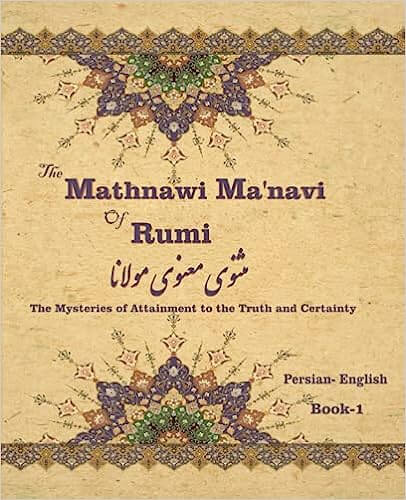
Mathnawi Book One – Rumi’s Masnavi, Persian–English Bilingual Edition — $17.50
Category: Rumi, All Books
Rumi’s Spiritual Couplets, Book One: the complete Persian text with Nicholson’s English translation on facing lines, from the Song of the Reed to the first great cycle of stories.
The complete Rumi guide
Read the Masnavi in Persian and English
Rumi's Spiritual Couplets, Book One: the complete Persian text with Nicholson's English translation on facing lines, from the Song of the Reed to the first great cycle of stories.

The stories everyone quotes from Rumi's Masnavi, gathered, untangled and retold in clear modern prose. The friendliest way into the Spiritual Couplets, in a 114-page edition.
Frequently asked questions about Masnavi translations
What is the best English translation of the Masnavi?
For accuracy, R. A. Nicholson's complete translation (1925–1940) is the scholarly standard. For the whole poem in modern verse, Jawid Mojaddedi's six-volume Oxford World's Classics translation, completed in 2025, is the best choice. Alan Williams's blank-verse edition with the Persian covers Books One and Two.
Is Coleman Barks a translator of Rumi?
Not in the usual sense. Coleman Barks does not read Persian; he rewrites earlier English translations, mainly Nicholson's, into free American verse. The Poetry Foundation calls him an interpreter rather than a translator. His books are popular poems inspired by Rumi, not translations of his words.
Who first translated the whole Masnavi into English?
Reynold A. Nicholson was the first to translate the entire Masnavi into English. His translation, with the Persian text and a commentary, was published by the Gibb Memorial Trust in eight volumes between 1925 and 1940, and it remains the scholarly reference.
Is there a Masnavi in Farsi with English translation?
Yes. Bilingual editions print the Persian text with an English translation. Alan Williams's 2020 edition has the Persian facing his English for Books One and Two, and Persian Bell's six-volume Mathnawi pairs the complete Persian text with Nicholson's translation, one book per volume.
How many volumes is the Masnavi in English?
Complete English translations usually come in six volumes, one for each book of the Masnavi, as in Mojaddedi's Oxford edition. Nicholson's original edition has eight volumes because it also includes the Persian text and two volumes of commentary.
Key takeaways
- Nicholson (1925–1940) is the complete, accurate scholarly translation.
- Mojaddedi (Oxford World’s Classics) is the complete modern verse translation, finished in 2025.
- Williams offers blank verse with the Persian for Books One and Two; Whinfield is an old abridgment.
- Barks writes free versions, not translations.
- A bilingual Persian–English edition is the best way to get close to Rumi’s own words.
Whichever translation you choose, keep the Persian within reach. Our Mathnawi Book One puts the original and Nicholson’s English side by side, so every line can be checked.
Sources
- Gibb Memorial Trust, Nicholson's Mathnawi
- Dar al-Masnavi, "About the Masnavi"
- National Library of Ireland, Whinfield 1887
- OUP, The Masnavi, Book One (Mojaddedi)
- OUP, The Masnavi, Book Six (Mojaddedi)
- Penguin, Spiritual Verses (Williams)
- British Institute of Persian Studies, The Masnavi of Rumi (Williams, 2020)
- Poetry Foundation, on Coleman Barks
- Dar al-Masnavi, "Versions by Coleman Barks"