📖 Reading time: 12 min
Quick answer: The Song of the Reed is the opening of Rumi’s Masnavi, traditionally its first eighteen couplets. It begins “Listen to this reed, how it complains” (beshno in ney chon shekayat mikonad). The reed flute, cut from its reed bed, cries for its home: an image of the human soul longing to return to God.
Who this is for: readers who know the reed flute poem from a translation and want the Persian, learners reading their first lines of Rumi, and anyone starting the Masnavi.
Few openings in world literature are as famous as this one. In eighteen couplets, Rumi introduces the voice, the image and the longing that run through all six books of the Masnavi.
An early account preserved by Dar al-Masnavi says that when Husam al-Din Chalabi asked Rumi for a long teaching poem, Rumi answered by putting the opening eighteen verses into his hand (Dar al-Masnavi). Some Mevlevi teachers call these lines a summary of the six books (Semazen.net).
Below you’ll find all eighteen couplets in Persian, a simple transliteration and a literal English translation, with short notes on the key images. Then we explain what the reed means and how to read the passage in Persian yourself.
What is the Song of the Reed?
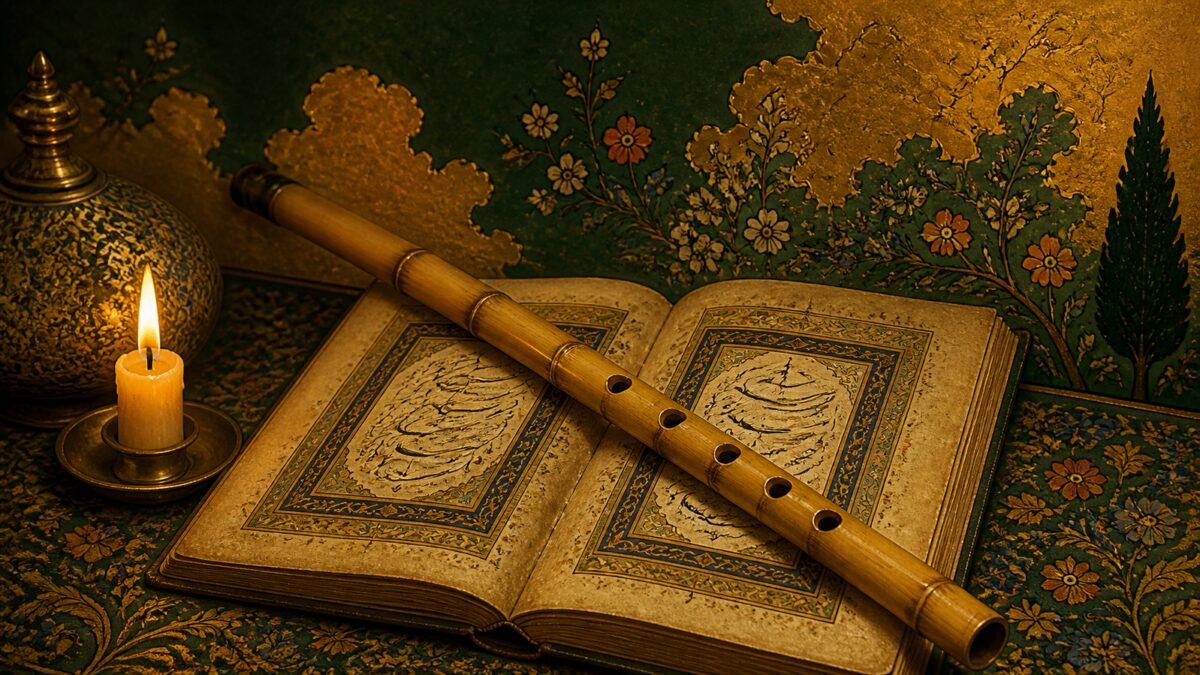
The Song of the Reed (Ney-nameh, “the book of the reed”) is the opening passage of the Masnavi. In it, a reed flute speaks: it was cut from the reed bed, and ever since, its music has been a lament for that lost home. Rumi uses the flute as an image of the soul, separated from God and longing to return.
The “eighteen lines” are a traditional unit, not a chapter of the printed text. In Ganjoor’s Persian text, the opening section continues for 34 couplets (Ganjoor); the reed speaks in the first eighteen, and Rumi then turns to the reader.
The eighteen couplets in Persian and English
The Persian follows Ganjoor’s text. The transliteration is simplified for English readers, and the translation is literal, to help you follow the original word by word.
Couplet 1
بشنو این نی چون شکایت میکند
از جداییها حکایت میکندBeshno in ney chon shekayat mikonad / az jodayiha hekayat mikonad
“Listen to this reed, how it complains:
it is telling a tale of separations.”
The reed flute (ney) is the soul, and its music is a lament. Rumi begins not with a lesson but with a sound.
Couplet 2
کز نِیِستان تا مرا بُبْریدهاند
در نَفیرم مرد و زن نالیدهاندKaz neyestan ta mara bobride-and / dar nafiram mard o zan nalide-and
“Ever since they cut me from the reed bed,
men and women have wept in my cry.”
The reed bed (neyestan) is the soul’s origin. Being cut from it is the first separation, and everyone who hears the reed recognizes their own.
Couplet 3
سینه خواهم شَرحهشَرحه از فراق
تا بگویم شرحِ دردِ اشتیاقSine khaham sharhe-sharhe az feraq / ta beguyam sharh-e dard-e eshtiyaq
“I want a breast torn, torn by parting,
so that I may tell the pain of longing.”
Couplet 4
هر کسی کو دور ماند از اصلِ خویش
باز جوید روزگارِ وصلِ خویشHar kasi ku dur mand az asl-e khish / baz juyad ruzgar-e vasl-e khish
“Everyone who is left far from his origin
seeks again the time of his union.”
This couplet is often called the key to the whole Masnavi: separation creates longing, and longing drives the return.
Couplet 5
من به هر جمعیّتی نالان شدم
جفت بدحالان و خوشحالان شدمMan be har jam'iyati nalan shodam / joft-e badhalan o khoshhalan shodam
“In every gathering I have wailed;
I have kept company with the unhappy and the happy.”
Couplet 6
هر کسی از ظَنّ خود شد یار من
از درون من نجُست اَسرار منHar kasi az zann-e khod shod yar-e man / az darun-e man najost asrar-e man
“Each became my friend from his own guess;
none sought my secrets from within me.”
People love the music for their own reasons and never ask what the reed itself is saying. A gentle warning about how we read Rumi, too.
Couplet 7
سِرِّ من از نالهٔ من دور نیست
لیک چشم و گوش را آن نور نیستSerr-e man az nale-ye man dur nist / lik cheshm o gush ra an nur nist
“My secret is not far from my lament,
but eye and ear lack the light to see it.”
Couplet 8
تن ز جان و جان ز تن مستور نیست
لیکْ کس را دیدِ جان دستور نیستTan ze jan o jan ze tan mastur nist / lik kas ra did-e jan dastur nist
“Body is not hidden from soul, nor soul from body,
yet no one is permitted to see the soul.”
Couplet 9
آتش است این بانگِ نای و نیست باد
هر که این آتش ندارد نیست بادAtash ast in bang-e nay o nist bad / har ke in atash nadarad nist bad
“This cry of the reed is fire, not wind:
whoever lacks this fire, may he be nothing!”
Rumi repeats the words nist bad with two meanings: in the first half, “is not wind”; in the second, “may he not exist”. The fire is love, the theme of the next line.
Couplet 10
آتشِ عشق است کاندر نیْ فتاد
جوششِ عشق است کاندر میْ فتادAtash-e eshq ast k-andar ney fetad / jushesh-e eshq ast k-andar mey fetad
“It is the fire of love that fell into the reed;
it is the ferment of love that fell into the wine.”
Love is the fire in the flute and the ferment in the wine, the same force in music and in ecstasy.
Couplet 11
نِی حریف هر که از یاری بُرید
پردههایش پردههای ما دریدNey harif-e har ke az yari borid / pardehayash pardehaye ma darid
“The reed is the companion of all who are parted from a friend;
its notes have torn our veils.”
Couplet 12
همچو نِی زَهری و تَریاقی که دید؟
همچو نِی دَمساز و مشتاقی که دید؟Hamcho ney zahri o taryaqi ke did? / hamcho ney damsaz o moshtaqi ke did?
“Who has seen a poison and an antidote like the reed?
Who has seen a comforter and a lover like the reed?”
Couplet 13
نِی حدیثِ راهِ پُرخون میکُند
قصّههای عشقِ مجنون میکندNey hadis-e rah-e porkhun mikonad / qessehaye eshq-e Majnun mikonad
“The reed tells of the path full of blood;
it tells the stories of Majnun's love.”
Majnun, the lover driven mad by love for Layla, is the classic Persian example of total love. The “path full of blood” is the path of that love.
Couplet 14
مَحرمِ این هوش، جُز بیهوش نیست
مَر زبان را مُشتری جز گوش نیستMahram-e in hush joz bihush nist / mar zaban ra moshtari joz gush nist
“Only the senseless is a confidant of this sense:
the tongue has no customer but the ear.”
Only someone who has lost ordinary “sense” can understand this kind of knowing. It is a paradox Rumi returns to again and again.
Couplet 15
در غمِ ما روزها بیگاه شد
روزها با سوزها همراه شدDar gham-e ma ruzha bigah shod / ruzha ba suzha hamrah shod
“In our grief the days have grown late;
the days have walked hand in hand with burning.”
Couplet 16
روزها گر رفت، گو «رو، باک نیست
تو بمان، ای آنکه چون تو پاک نیست»Ruzha gar raft gu ro bak nist / to beman ey anke chon to pak nist
“If the days are gone, say, "Go, it does not matter.
You remain, O you whose purity has no equal."”
Couplet 17
هر که جز ماهی ز آبش سیر شد
هر که بیروزیسْت، روزش دیر شدHar ke joz mahi ze abash sir shod / har ke bi-ruzi-st ruzash dir shod
“Everyone but the fish has had his fill of His water;
for whoever lacks his daily bread, the day grows long.”
The fish never tires of water: the true lover never has enough of God. Whoever is without that “daily bread” finds the day endless.
Couplet 18
در نیابد حالِ پُخته هیچ خام
پس سخن کوتاه باید والسّلامDar nayabad hal-e pokhte hich kham / pas sokhan kutah bayad, vassalam
“No raw one understands the state of the ripe;
so the talk must be short. Farewell.”
The “raw” and the “cooked” (ripe) are the beginner and the one transformed by love. Rumi cuts himself short: some things cannot be explained, only lived.
What the reed means
The reed is the human soul, the reed bed is its origin with God, and the reed’s music is the soul’s longing to go home. The flute can only sing because it has been cut and hollowed out: the pain of separation is what makes the music possible.
- The reed bed (neyestan): the soul’s first home, before it came into the world.
- The cutting: birth into this world, and every separation from what we love.
- The lament: longing, which Rumi treats as a gift because it points home.
- The fire: love, which turns the reed’s breath into music.
- The raw and the ripe: the difference between hearing about love and being transformed by it.
Readers have also seen the reed as the perfect human being, or as Rumi himself, emptied of self so that the divine breath can play through him. The passage holds all these readings at once, which is why it has been commented on for centuries.
How to read the passage in Persian
- Read couplet 1 aloud ten times. The meter (fa’elaton fa’elaton fa’elon) carries the whole Masnavi. Once it is in your ear, every line is easier.
- Notice the rhyme pairs. Each couplet rhymes with itself: mikonad / mikonad, bobride-and / nalide-and. That is what “masnavi” means.
- Learn the key words. ney (reed), jodayi (separation), asl (origin), vasl (union), eshq (love), atash (fire).
- Read with a literal translation beside you. Check every word, then read the Persian again without it.
- Memorize the first four couplets. Many Iranians can recite them, and they will carry you into the rest of the book.
For a fuller plan, see how to read Rumi in Persian.
Translations of the opening
Almost every translator of Rumi has tried these lines. Nicholson’s complete prose translation is the scholarly reference; Jawid Mojaddedi renders them in rhyming couplets (Oxford University Press); Alan Williams uses blank verse (Penguin). Comparing two of them with the Persian is one of the best ways to learn how translation works. Our guide to the Masnavi in English compares them.
📚 More from Persian Bell
🎯 Recommended Book
Mathnawi Book One – Rumi’s Masnavi, Persian–English Bilingual Edition — $17.50
Category: Rumi, All Books
Rumi’s Spiritual Couplets, Book One: the complete Persian text with Nicholson’s English translation on facing lines, from the Song of the Reed to the first great cycle of stories.
The complete Rumi guide
Frequently asked questions about the Song of the Reed
What is the Song of the Reed?
The Song of the Reed is the opening passage of Rumi's Masnavi, traditionally its first eighteen couplets. A reed flute complains that it was cut from its reed bed and longs to return. Rumi uses it as an image of the human soul separated from God.
What is the first line of the Masnavi?
The first line is "Beshno in ney chon shekayat mikonad, az jodayiha hekayat mikonad": "Listen to this reed, how it complains: it is telling a tale of separations." In Persian it is بشنو این نی چون شکایت میکند.
Why are there eighteen lines?
Eighteen is the traditional length of the reed's song: an early account says Rumi gave his disciple Husam al-Din the opening eighteen verses. In printed editions the opening section runs longer, 34 couplets in Ganjoor's text, but the reed speaks in the first eighteen.
What does the reed symbolize in Rumi?
The reed symbolizes the human soul, cut off from its divine origin (the reed bed) and longing to return. Its music is that longing. Because the flute must be hollow to sing, it also stands for the person emptied of ego through whom love can speak.
What is a ney?
The ney is the end-blown reed flute of Persian, Turkish and Arab music, and the central instrument of Mevlevi music. Rumi's word for the reed in the Masnavi is ney, so the image is both a plant and a musical instrument.
Key takeaways
- The Song of the Reed is the opening of the Masnavi, traditionally eighteen couplets long.
- It begins “Listen to this reed, how it complains: it is telling a tale of separations.”
- The reed is the soul, the reed bed its origin, and its music the longing to return.
- Read it aloud in Persian with a literal translation, and memorize the first four couplets.
Once the reed’s song is in your ear, the rest of the Masnavi opens up. Continue with the stories of Mathnawi Book One, complete in Persian and English, or read our guide to the whole Masnavi.