
📖 Reading time: 10 min
Quick answer: The Masnavi has six books (daftars) and about 25,000 to 26,000 couplets. Book One opens with the Song of the Reed and the first great stories; Book Two turns to the seeker and the ego; Book Three is about knowledge (the Elephant in the Dark); Book Four about the true guide; Book Five about losing the self; and Book Six ends with an unfinished tale.
Who this is for: readers deciding which book of the Masnavi to read, students looking for a summary of each book, and anyone wondering what Book 1 or Book 6 contains.
Rumi’s Masnavi is too long to read in one go, which is why it has always been printed and studied book by book. Each of its six books has its own preface by Rumi, its own favorite stories and its own emphasis.
This guide summarizes all six books: how long each is, what it is about and which stories to look for. The couplet counts come from Ganjoor’s Persian text and from the Konya manuscript as reported by Dar al-Masnavi (Ganjoor; Dar al-Masnavi). At the end you’ll find which book to start with.
The six books at a glance
| Book | Couplets (Ganjoor) | Couplets (Konya MS) | Known for |
|---|---|---|---|
| Book 1 | 4,013 | 4,019 | The Song of the Reed |
| Book 2 | 3,819 | 3,721 | Moses and the Shepherd |
| Book 3 | 4,809 | 4,811 | The Elephant in the Dark |
| Book 4 | 3,851 | 3,855 | Solomon and the Queen of Sheba |
| Book 5 | 4,233 | 4,240 | Stories of desire and self-deception |
| Book 6 | 4,912 | 4,929 | The Three Princes and the Fortress of Forms (unfinished) |
| Total | about 25,637 | 25,575 | Six books, unfinished |
Counts vary slightly between editions; Nicholson’s edition totals 25,632 lines and Britannica rounds to “nearly 26,000 couplets”.
Book One: the reed and the first great stories
Oxford University Press calls Book One “full of stories, and often funny”, drawing “on sources from sacred history to folklore and fable” (OUP). It opens with the Song of the Reed, and its first story, the King and the Handmaiden, introduces the Masnavi’s method: a tale whose real meaning is “the substance of our own state”.
Stories and passages to look for
- The Song of the Reed
- The King and the Handmaiden (the first story)
- The Grocer and the Parrot
- The Lion and the Hare
- The Merchant and the Parrot
- The contest of the Chinese and Greek painters
بشنوید ای دوستان این داستان
خود حقیقت نقدِ حالِ ماست آن“Listen, O friends, to this story:
in truth it is the very substance of our present state.”
Read the whole of Book 1 in Persian with Nicholson’s English translation in our Mathnawi Book One edition.
The opening is explained line by line in our guide to the Song of the Reed, and the stories are retold in famous Masnavi stories.
Book Two: the seeker and the self
OUP describes Book Two as “concerned with the challenges facing the seeker of Sufi enlightenment”, from fighting the ego to choosing the right companions (OUP). Its most famous story is Moses and the Shepherd, a lesson that God looks at the heart, not the words.
Stories and passages to look for
- Moses and the Shepherd
- Mu'awiya and Satan
- Stories about false friends and true companions
تو برای وصل کردن آمدی
یا برای فَصل کردن آمدی؟“Did you come to bring together,
or did you come to tear apart?”
Read the whole of Book 2 in Persian with Nicholson’s English translation in our Mathnawi Book Two edition.
Book Three: knowledge and the elephant in the dark
OUP notes that Book Three focuses on epistemology, how we know what we know, and that many of its stories “involve eating and food” (OUP). It is the second-longest book and one of the richest in stories, including the famous Elephant in the Dark.
Stories and passages to look for
- The Elephant in the Dark
- The People of Saba
- Many tales of hunger, eating and appetite
پیل اندر خانهٔ تاریک بود
عرضه را آورده بودندش هُنود“The elephant was in a dark house;
some Hindus had brought it there to show it.”
Read the whole of Book 3 in Persian with Nicholson’s English translation in our Mathnawi Book Three edition.
Book Four: the true guide
OUP describes the central concern of Book Four as knowing the spiritual guide, with stories that include Solomon and the Queen of Sheba and a series of animal fables (OUP). It also contains one of the few popular “Rumi quotes” that really is his: “Sell cleverness and buy bewilderment”.
Stories and passages to look for
- Solomon and the Queen of Sheba
- The building of the Farther Mosque
- Animal fables about wisdom and folly
زیرکی بفروش و حیرانی بخر
زیرکی ظنست و حیرانی نظر“Sell cleverness and buy bewilderment:
cleverness is opinion, and bewilderment is vision.”
Read the whole of Book 4 in Persian with Nicholson’s English translation in our Mathnawi Book Four edition.
Book Five: losing the self
OUP calls Book Five the book that follows “the path of annihilation of the self in a total and uncompromising way”, and notes that it is known for its frank sexual content (OUP). It is the most daring of the six books, and its stories are often the bluntest.
Stories and passages to look for
- Stories of desire and self-deception
- Parables on dying to the self
Read the whole of Book 5 in Persian with Nicholson’s English translation in our Mathnawi Book Five edition.
Book Six: the fortress and the unfinished tale
OUP says Book Six “interweaves amusing stories with homilies and lyrical flights” (OUP). It ends with the long story of a king’s three sons who enter a forbidden fortress of images, a tale that breaks off unfinished: Rumi died before completing it (Dar al-Masnavi).
Stories and passages to look for
- The Three Princes and the Fortress of Forms (unfinished)
بود شاهی شاه را بد سه پسر
هر سه صاحبفطنت و صاحبنظر“There was a king, and the king had three sons,
all three clever and full of insight.”
Read the whole of Book 6 in Persian with Nicholson’s English translation in our Mathnawi Book Six edition.
Which book of the Masnavi should you read first?
Start with Book One. It contains the Song of the Reed, the most famous stories and the clearest introduction to Rumi’s method, and later books assume you know it. If you want an easier way in, read the stories first in a retelling, then come back to the verse.
- For a first reading: Book One, a few pages a day.
- For the best stories: Books One and Three.
- For Rumi’s teaching on the spiritual life: Books Two and Four.
- For experienced readers: Books Five and Six.
To read in Persian, follow our step-by-step plan for reading Rumi in Persian; to choose an English version, see the Masnavi in English.
📚 More from Persian Bell
🎯 Recommended Book
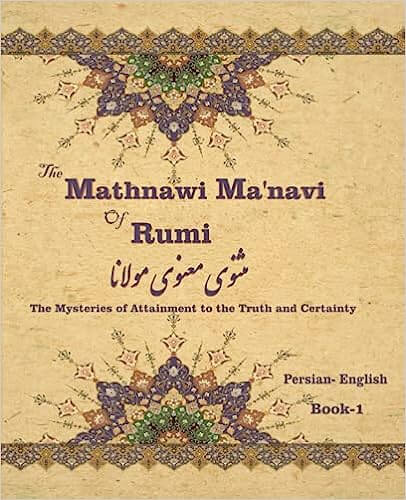
Mathnawi Book One – Rumi’s Masnavi, Persian–English Bilingual Edition — $17.50
Category: Rumi, All Books
Rumi’s Spiritual Couplets, Book One: the complete Persian text with Nicholson’s English translation on facing lines, from the Song of the Reed to the first great cycle of stories.
The complete Rumi guide
The Mathnawi in six bilingual volumes
Rumi's Spiritual Couplets, Book One: the complete Persian text with Nicholson's English translation on facing lines, from the Song of the Reed to the first great cycle of stories.
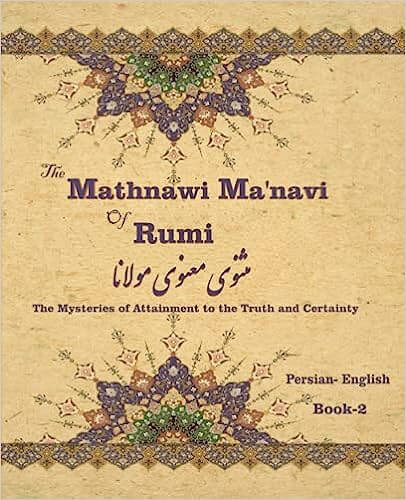
The second book of Rumi's Spiritual Couplets in Persian and English: the journey beyond the self, with the complete original text and Nicholson's translation on every page.
Book Three of the Spiritual Couplets, complete in Persian and English: Rumi's richest storytelling, from the elephant in the dark to the people of Saba, with Nicholson's translation.
The fourth book of Rumi's Masnavi in Persian and English: Solomon and the Queen of Sheba, the building of the Farther Mosque and the wisdom of the true guide, with Nicholson's translation.
Book Five of the Spiritual Couplets, Rumi on love, desire and the Beloved, in the complete Persian text with Nicholson's English translation alongside.
The sixth and final book of Rumi's Spiritual Couplets, complete in Persian and English: the unfinished tale of the three princes, with Nicholson's translation.
Frequently asked questions about the books of the Masnavi
How many books are in the Masnavi?
The Masnavi has six books, called daftars in Persian. Each book opens with a short prose preface by Rumi, and together they contain about 25,000 to 26,000 rhyming couplets. Printed editions usually publish them as six volumes.
What is Masnavi Book 1 about?
Book One opens with the Song of the Reed and contains many of the Masnavi's best-known stories, including the King and the Handmaiden, the Grocer and the Parrot, the Lion and the Hare and the Merchant and the Parrot. Oxford University Press describes it as full of stories and often funny.
Which book of the Masnavi is the longest?
Book Six is the longest, with about 4,900 couplets (4,912 in Ganjoor's text, 4,929 in the Konya manuscript), followed by Book Three at about 4,810. Book Two is the shortest, at about 3,700 to 3,800 couplets.
Is Book Six of the Masnavi unfinished?
Yes. Book Six ends with the story of a king's three sons and a forbidden fortress of images, and the story breaks off before its end because Rumi died in 1273 while still working on the poem. The standard text stops there.
Which book of the Masnavi should I read first?
Read Book One first. It contains the famous opening and the clearest introduction to Rumi's way of teaching through stories, and the later books build on it. If verse feels hard, read a prose retelling of the stories first and then return to Book One.
Key takeaways
- The Masnavi has six books and about 25,000–26,000 couplets.
- Book One holds the Song of the Reed and the best-known stories; start there.
- Book Two is about the seeker and the ego, Book Three about knowledge, Book Four about the guide.
- Book Five is the most daring; Book Six ends with an unfinished story.
Each book of the Masnavi is a world of its own, and all six are available in Persian with Nicholson’s English translation: start with Mathnawi Book One, or see all six volumes.