📖 Reading time: 12 min
Quick answer: The most famous Masnavi stories include the King and the Handmaiden, the Grocer and the Parrot, the Lion and the Hare and the Merchant and the Parrot (Book One), Moses and the Shepherd (Book Two), the Elephant in the Dark (Book Three) and the unfinished tale of the Three Princes (Book Six). Each teaches a spiritual lesson through a simple, often funny tale.
Who this is for: readers who want the stories of the Masnavi without reading 25,000 couplets, teachers and storytellers, and Persian learners looking for a way into Rumi.
Rumi taught through stories. The Masnavi is full of them, from royal romances to animal fables and jokes, and they are the easiest way into the whole poem.
Below are eight of the best-known stories, each placed in its book and section (confirmed in Ganjoor’s Persian text, Ganjoor), with the opening line in Persian and English, a short retelling and what the story teaches.
Remember that in the Masnavi, stories rarely run straight: Rumi interrupts them with reflections and other tales. The retellings here follow the main thread.
The stories at a glance
| Story | Book | Lesson |
|---|---|---|
| The King and the Handmaiden | Book 1 | The first story of the Masnavi warns that love for outward beauty is not lasting love. |
| The Grocer and the Parrot | Book 1 | We judge others by comparing them with ourselves, and get it wrong. |
| The Lion and the Hare | Book 1 | The story begins with a debate about trusting in God versus making an effort, and ends with the lion destroyed by his own image: the enemy we attack is often ourselves. |
| The Merchant and the Parrot | Book 1 | To escape the cage of the ego, you must "die before you die". |
| The Chinese and the Greek Painters | Book 1 | The Greeks are the Sufis, who do not collect learning but polish the heart until it reflects everything. |
| Moses and the Shepherd | Book 2 | God looks at the heart, not the words. |
| The Elephant in the Dark | Book 3 | Each of us grasps only part of the truth. |
| The Three Princes and the Fortress of Forms | Book 6 | The fortress of images is the world of forms that captivates the soul. |
The King and the Handmaiden
Masnavi, Book 1.
بشنوید ای دوستان این داستان
خود حقیقت نقدِ حالِ ماست آن“Listen, O friends, to this story:
in truth it is the very substance of our present state.”
A king falls in love with a young handmaiden, but she falls ill and his doctors cannot cure her. A divine physician, sent to the king in a dream, sees that her illness is love: she longs for a goldsmith of Samarkand.
The goldsmith is brought to court and married to her, but the physician gives him a potion that makes him waste away, and as his beauty fades, her love for him fades too.
What it teaches: The first story of the Masnavi warns that love for outward beauty is not lasting love. Rumi tells us at the start that the story is about "our own state": we are the king, the handmaiden and the goldsmith.
The Grocer and the Parrot
Masnavi, Book 1.
بود بقّالی و وی را طوطی ای
خوشنوایی سبز و گویا طوطی ای“There was a grocer who had a parrot,
a sweet-voiced, green, talking parrot.”
A grocer keeps a clever parrot that chats with his customers. One day, startled, the parrot knocks over the oil bottles. The angry grocer hits it on the head, its feathers fall out, and it stops speaking.
Days later a bald dervish walks by, and the parrot suddenly cries out: "Did you spill oil too?"
What it teaches: We judge others by comparing them with ourselves, and get it wrong. Rumi uses the joke to warn against reasoning by surface likeness.
The Lion and the Hare
Masnavi, Book 1.
طایفهٔ نخچیر دَر وادی خوش
بودشان از شیر دایم کشمکش“A tribe of wild beasts in a pleasant valley
were in constant struggle with a lion.”
The animals of a valley agree to send the lion one of their number each day if he stops hunting them. When the hare's turn comes, he arrives late and tells the lion another lion stopped him on the way.
He leads the furious lion to a deep well, where the lion sees his own reflection, takes it for his rival and leaps in to his death.
What it teaches: The story begins with a debate about trusting in God versus making an effort, and ends with the lion destroyed by his own image: the enemy we attack is often ourselves.
The Merchant and the Parrot
Masnavi, Book 1.
بود بازرگان و او را طوطیی
در قفس محبوس زیبا طوطیی“There was a merchant who had a parrot,
a beautiful parrot shut in a cage.”
Before a trip to India, a merchant asks his caged parrot what message to take to its kin. When he describes the parrot's captivity to the parrots of India, one of them falls down as if dead.
Back home he tells the story, and his own parrot falls down "dead" in the cage. The grieving merchant throws it out, and it flies away free: it had understood the message.
What it teaches: To escape the cage of the ego, you must "die before you die". The Indian parrot's fall was a lesson, and only the caged parrot understood it.
The Chinese and the Greek Painters
Masnavi, Book 1.
چینیان گفتند ما نقاشتر
رومیان گفتند ما را کر و فر“The Chinese said, "We are the better painters";
the Greeks said, "Ours is the skill and the splendor."”
A king holds a contest between Chinese and Greek ("Rumi") painters, giving each a wall facing the other with a curtain between them. The Chinese cover their wall with brilliant paintings; the Greeks only polish theirs.
When the curtain is lifted, the polished wall reflects the Chinese paintings, more beautiful still in its clear surface.
What it teaches: The Greeks are the Sufis, who do not collect learning but polish the heart until it reflects everything.
Moses and the Shepherd
Masnavi, Book 2.
تو کجایی تا شوم من چاکرت
چارقت دوزم کنم شانه سرت“Where are You, that I may become Your servant,
sew Your shoes and comb Your hair?”
Moses hears a shepherd praying in simple, clumsy words: he would mend God's shoes, comb His hair and bring Him milk. Moses scolds him for blasphemy, and the ashamed shepherd wanders off into the desert.
Then God rebukes Moses: "Did you come to bring together, or did you come to tear apart?" Moses runs after the shepherd to tell him he may pray however he likes.
What it teaches: God looks at the heart, not the words. It is one of the Masnavi's best-loved lessons about sincerity and humility.
تو برای وصل کردن آمدی
یا برای فَصل کردن آمدی؟“Did you come to bring together,
or did you come to tear apart?”
The Elephant in the Dark
Masnavi, Book 3.
پیل اندر خانهٔ تاریک بود
عرضه را آورده بودندش هُنود“The elephant was in a dark house;
some Hindus had brought it there to show it.”
Some people are brought into a dark house to see an elephant. Unable to see, each one feels it with his hand: one touches the trunk and says it is like a water pipe, another the ear and says it is a fan, another the leg and says it is a pillar, another the back and says it is a throne.
Rumi concludes that if each had held a candle, their disagreement would have disappeared.
What it teaches: Each of us grasps only part of the truth. The "candle" is real insight, which reconciles partial views.
دیدنش با چشم چون ممکن نبود
اندر آن تاریکیش کف میبِسود“Since seeing it with the eye was not possible,
each one felt it with his palm in that darkness.”
The Three Princes and the Fortress of Forms
Masnavi, Book 6.
بود شاهی شاه را بد سه پسر
هر سه صاحبفطنت و صاحبنظر“There was a king, and the king had three sons,
all three clever and full of insight.”
A king sends his three sons out into the world but warns them never to enter a certain fortress. Curiosity wins: inside they find a hall of pictures, among them the portrait of a beautiful princess of China, and all three fall in love.
They set out for China to find her. The story is the last in the Masnavi, and it breaks off unfinished.
What it teaches: The fortress of images is the world of forms that captivates the soul. That the Masnavi ends mid-story, still on the road, feels fitting.
How to read the stories of the Masnavi
- Start with a retelling. Knowing the plot first makes the verse much easier to follow.
- Then read the verse. The stories live in Rumi’s lines, his jokes and his asides.
- Follow the digressions. When Rumi breaks off, the new tale usually explains the old one.
- Ask “who am I in this story?” Rumi says at the start that the tales describe our own state.
Most of these stories are in Book One; see our guide to the six books to find more, and how to read Rumi in Persian for a reading plan.
📚 More from Persian Bell
🎯 Recommended Book
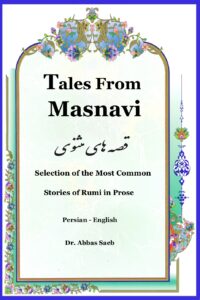
Tales From Masnavi – Rumi’s Best-Known Stories Retold in Plain English — $9.99
Category: Rumi
The stories everyone quotes from Rumi’s Masnavi, gathered, untangled and retold in clear modern prose. The friendliest way into the Spiritual Couplets, in a 114-page edition.
The complete Rumi guide
Read the stories in English, or in Persian and English

The stories everyone quotes from Rumi's Masnavi, gathered, untangled and retold in clear modern prose. The friendliest way into the Spiritual Couplets, in a 114-page edition.
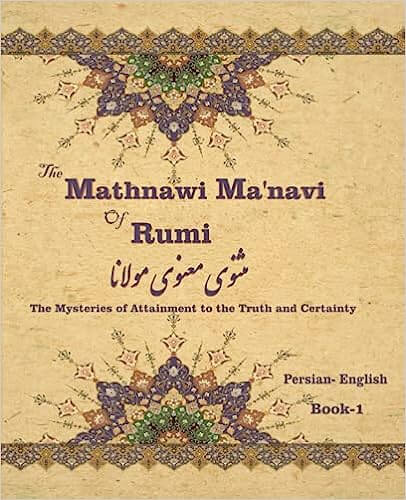
Rumi's Spiritual Couplets, Book One: the complete Persian text with Nicholson's English translation on facing lines, from the Song of the Reed to the first great cycle of stories.
Frequently asked questions about Masnavi stories
What is the most famous story in the Masnavi?
The Elephant in the Dark (Book Three) is probably the best known: people in a dark room each touch one part of an elephant and describe it differently. Moses and the Shepherd (Book Two) and the Merchant and the Parrot (Book One) are almost as famous.
What is the first story in the Masnavi?
The first story is the King and the Handmaiden, which follows the Song of the Reed in Book One. A king loves a handmaiden who falls ill for love of a goldsmith; a divine physician cures her. Rumi tells readers the story is about their own inner state.
What is the moral of the Elephant in the Dark?
Each person who touches the elephant in the dark grasps only one part and mistakes it for the whole, so they disagree. Rumi concludes that if each had a candle, the disagreement would vanish: real insight reconciles partial views of the truth.
What is the lesson of Moses and the Shepherd?
God values sincerity over correct words. Moses scolds a shepherd for his naive prayer, and God rebukes Moses: "Did you come to bring together, or to tear apart?" The story teaches humility and respect for every honest way of praying.
Is there a book of Masnavi stories in English?
Yes. Several books retell the stories of the Masnavi in prose. Persian Bell's Tales From Masnavi retells Rumi's best-known stories in plain modern English in 114 pages, and the six-volume Mathnawi gives the full Persian text with Nicholson's translation.
Key takeaways
- The Masnavi teaches through hundreds of stories, many of them in Book One.
- The best known include the Elephant in the Dark, Moses and the Shepherd and the Merchant and the Parrot.
- Each story carries a lesson about the soul, the ego or love, and Rumi says they describe “our own state”.
- Read a retelling first, then the verse.
The stories are the friendliest way into Rumi. Read them all in Tales From Masnavi, then meet them in Rumi’s own verse in Mathnawi Book One, Persian and English side by side.