📖 Reading time: 9 min
Quick answer: Some popular Rumi quotes are genuine, such as “Sell your cleverness and buy bewilderment” (Masnavi, Book Four). Many others are loose modern versions, like Coleman Barks’s “Out beyond ideas of wrongdoing and rightdoing”, and some are not Rumi at all: “Yesterday I was clever, so I wanted to change the world” is by Sri Chinmoy. A real Rumi quote can be traced to a Persian line.
Who this is for: readers who want to quote Rumi accurately, writers checking a quote before using it, and Persian learners who want the original words.
Rumi may be the most quoted poet on the internet, and the most misquoted. Many of the lines that circulate under his name are modern versions that drift far from the Persian, and a few were written by other people entirely.
This guide sorts popular “Rumi quotes” into three groups: genuine lines you can trace to the Persian, loose adaptations, and quotes that are not Rumi’s. For the genuine ones we give the Persian original and a literal translation. Then we show you how to check any quote yourself.
Popular Rumi quotes checked
| Quote | Verdict | Source |
|---|---|---|
| "Sell your cleverness and buy bewilderment" | Genuine | Masnavi, Book Four |
| "Listen to the reed, how it tells a tale…" | Genuine | Masnavi, Book One, first line |
| "Everyone who is far from his origin seeks to return" | Genuine | Masnavi, Book One, opening |
| "Out beyond ideas of wrongdoing and rightdoing, there is a field" | Loose adaptation | Barks's version of a quatrain about "Islam and unbelief" |
| "The wound is the place where the Light enters you" | Loose adaptation | Condensed from a Barks poem |
| "Let yourself be silently drawn by the strange pull of what you really love" | Unverified | A Barks rendering; Persian source not identified |
| "What you seek is seeking you" | Untraced | No Persian source found |
| "Yesterday I was clever, so I wanted to change the world…" | Not Rumi | Sri Chinmoy, 1982 |
Why so many Rumi quotes are not real
Most Rumi quotes in English come from popular “versions” rather than translations. Coleman Barks, whose books made Rumi a bestseller, does not read Persian; the Poetry Foundation calls him “not a translator so much as an interpreter” (Poetry Foundation). His poems are reworkings of older English translations, and the shorter and freer a line becomes, the further it can drift from Rumi.
Writers such as Rozina Ali have also pointed out that these versions often remove Rumi’s Islamic references (Poetry Foundation). Add the internet’s habit of attaching famous names to anonymous sayings, and you get thousands of “Rumi quotes” with no Persian behind them.
Genuine Rumi quotes in Persian and English
These lines come from the Masnavi. The Persian follows Ganjoor’s text; the English is Persian Bell’s literal translation.
“Sell your cleverness and buy bewilderment”
زیرکی بفروش و حیرانی بخر
زیرکی ظنست و حیرانی نظرZiraki befrush o heyrani bekhar / ziraki zann ast o heyrani nazar
“Sell cleverness and buy bewilderment:
cleverness is opinion, and bewilderment is vision.”
Genuine, from Book Four. The popular English is close to the Persian. Rumi contrasts clever guesswork (zann) with the wonder that truly sees (nazar).
“Listen to this reed”
بشنو این نی چون شکایت میکند
از جداییها حکایت میکندBeshno in ney chon shekayat mikonad / az jodayiha hekayat mikonad
“Listen to this reed, how it complains:
it is telling a tale of separations.”
The first line of the Masnavi. Read the whole passage in the Song of the Reed.
“Everyone far from his origin”
هر کسی کو دور ماند از اصلِ خویش
باز جوید روزگارِ وصلِ خویشHar kasi ku dur mand az asl-e khish / baz juyad ruzgar-e vasl-e khish
“Everyone who is left far from his origin
seeks again the time of his union.”
Often quoted as “Whoever is separated from their source longs to return.” Genuine, and the key idea of the whole Masnavi.
“Did you come to unite or to separate?”
تو برای وصل کردن آمدی
یا برای فَصل کردن آمدی؟To baraye vasl kardan amadi / ya baraye fasl kardan amadi?
“Did you come to bring together,
or did you come to tear apart?”
God’s words to Moses in the story of Moses and the Shepherd (Book Two). Read the story in famous Masnavi stories.
“The raw cannot understand the ripe”
در نیابد حالِ پُخته هیچ خام
پس سخن کوتاه باید والسّلامDar nayabad hal-e pokhte hich kham / pas sokhan kutah bayad, vassalam
“No raw one understands the state of the ripe;
so the talk must be short. Farewell.”
Loose adaptations
“Out beyond ideas of wrongdoing and rightdoing, there is a field. I’ll meet you there.”
This is Coleman Barks’s version of a quatrain from the Divan-e Shams. Dar al-Masnavi gives the literal sense of the original: “Beyond Islam and unbelief there is a ‘desert plain’. For us there is a ‘yearning’ in the midst of that expanse” (Dar al-Masnavi). Rumi wrote about religion and unbelief, not “wrongdoing and rightdoing”. The image of meeting beyond them is his; the moral framing is modern.
“The wound is the place where the Light enters you.”
A condensed form of a line in Barks’s poem “Childhood Friends”, “Keep looking at the bandaged place. That’s where the light enters you.” A quotes site that tracks sources lists it as disputed (GraciousQuotes). The Persian line behind it has not been reliably identified, so quote it as Barks, not as Rumi’s exact words.
“Let yourself be silently drawn by the strange pull of what you really love.”
This appears to be a Barks rendering; the same source gives his wording as “Let yourself be drawn by the stronger pull of that which you truly love” and notes that the original has not been located (GraciousQuotes). Treat it as unverified.
Quotes that are not Rumi
“Yesterday I was clever, so I wanted to change the world. Today I am wise, so I am changing myself.”
Not Rumi. This is by the Indian spiritual teacher Sri Chinmoy, published as “Today I Am Wise” in Ten Thousand Flower-Flames (1982) (Sri Chinmoy Library). It is one of the most widely misattributed “Rumi quotes”.
“What you seek is seeking you.”
We could not trace this line to any Persian source or to a specific English translation of Rumi. It sounds like Rumi, but until someone finds the original, it should not be quoted as his.
How to check a Rumi quote
- Ask for the source. A real quote can be traced to a book (Masnavi or Divan-e Shams) and a poem or line number.
- Find the Persian. Search a few key words on Ganjoor, the free online library of Persian poetry. If no Persian line matches, be suspicious.
- Compare a literal translation. Nicholson for the Masnavi, or a bilingual edition, shows whether the popular version is close.
- Be wary of very short, very modern lines. Self-help wording (“your life”, “the universe”) is usually a sign of a later version.
- Credit honestly. If you love a Barks version, quote it as “Rumi, in Coleman Barks’s version”.
To read Rumi’s own words, start with a faithful translation; our guide to the Masnavi in English explains the options.

📚 More from Persian Bell
🎯 Recommended Book
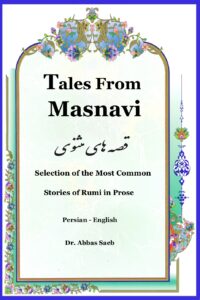
Tales From Masnavi – Rumi’s Best-Known Stories Retold in Plain English — $9.99
Category: Rumi
The stories everyone quotes from Rumi’s Masnavi, gathered, untangled and retold in clear modern prose. The friendliest way into the Spiritual Couplets, in a 114-page edition.
The complete Rumi guide
Frequently asked questions about Rumi quotes
Are Rumi quotes real?
Some are and many are not. Lines such as "Sell your cleverness and buy bewilderment" come straight from the Masnavi. Many popular quotes are loose modern versions by Coleman Barks, who does not read Persian, and some, like "Yesterday I was clever", were written by other people.
Did Rumi say "Out beyond ideas of wrongdoing and rightdoing"?
Not in those words. It is Coleman Barks's free version of a quatrain whose literal meaning is "Beyond Islam and unbelief there is a desert plain; for us there is a yearning in the midst of that expanse." Rumi wrote about religion and unbelief, not right and wrong.
Who said "Yesterday I was clever, so I wanted to change the world"?
Sri Chinmoy wrote it, not Rumi. It appears as "Today I Am Wise" in his collection Ten Thousand Flower-Flames, published in 1982. It is often shared online with Rumi's name attached.
Is "What you seek is seeking you" by Rumi?
There is no known Persian source for this line, and we could not trace it to any published translation of Rumi. It may be a paraphrase or a modern saying. Until an original is found, it should not be quoted as Rumi's words.
How can I tell if a Rumi quote is genuine?
Look for a source you can check: the book (Masnavi or Divan-e Shams) and a line or poem number. Then find the Persian on Ganjoor and compare a literal translation. Quotes with no Persian original, or with modern self-help wording, are usually later versions.
Key takeaways
- Genuine Rumi quotes can be traced to a Persian line in the Masnavi or the Divan-e Shams.
- Many popular quotes are loose Barks versions, and a few are by other people entirely.
- “Sell your cleverness and buy bewilderment” is real; “Yesterday I was clever” is Sri Chinmoy.
- Check quotes on Ganjoor or in a bilingual edition, and credit versions honestly.
The surest way to quote Rumi well is to read him: start with the Song of the Reed, or with the stories in Tales From Masnavi.