📖 Reading time: 9 min
Quick answer: To read Rumi in Persian, learn the script, then start with the first eighteen lines of the Masnavi (the Song of the Reed): read each couplet aloud to catch the meter, check every word against a literal translation, and learn about twenty key words. Then move on to the stories of Book One, a few couplets a day, with a bilingual edition.
Who this is for: Persian learners from about intermediate level, heritage speakers who understand spoken Persian but find classical poetry hard, and English readers who want to get closer to Rumi’s words.
Reading Rumi in Persian is more achievable than it looks. The Masnavi uses one meter for all its 25,000-odd couplets, its vocabulary repeats, and many of its lines are as clear as everyday speech.
This guide gives you a practical plan: what to learn first, how to read a couplet, which words to know, a 30-day starter routine and the best passages to begin with. It brings together the advice from our earlier Rumi reading guides in one place.

What you need before you start
- The Persian script. You can start with transliteration, but the rhyme and wordplay live in the script. Learn the alphabet first.
- Basic grammar. Present and past verbs, the ezafe (the “-e” that links words) and pronoun suffixes cover most of what you meet.
- A literal translation. Not a poetic version: you need to see what each word means.
- Patience with old forms. Rumi’s Persian is 750 years old. Most of it is close to modern Persian, but some forms and spellings differ.
New to the script? Our Persian Alphabet for Beginners is a gentle start, and our post on reading Rumi in Persian handwriting helps heritage readers make the jump from speaking to reading.
How the Masnavi sounds: the meter
Every couplet of the Masnavi uses the same meter, called ramal: fa-‘e-la-ton / fa-‘e-la-ton / fa-‘e-lon, long-short-long-long, long-short-long-long, long-short-long (Ganjoor). Once that rhythm is in your ear, you can read any line of the poem.
بشنو این نی چون شکایت میکند
از جداییها حکایت میکندBeshno in ney chon shekayat mikonad / az jodayiha hekayat mikonad
“Listen to this reed, how it complains:
it is telling a tale of separations.”
Read it aloud slowly: besh-no-in-ney / chon-she-ka-yat / mi-ko-nad. Tap the rhythm on the table. Do this with the first four couplets until it feels natural.
Our post on Rumi Persian pronunciation drills has more exercises.
How to read a couplet
- Read it aloud twice without translating, just for the sound.
- Split it into its two halves. Each half (mesra’) is usually a complete phrase.
- Find the verb. Persian verbs come at the end of the clause: mikonad, “does”.
- Check every word against a literal translation, and note any new word in a notebook.
- Read the Persian again and say the meaning in your own words.
هر کسی کو دور ماند از اصلِ خویش
باز جوید روزگارِ وصلِ خویشHar kasi ku dur mand az asl-e khish / baz juyad ruzgar-e vasl-e khish
“Everyone who is left far from his origin
seeks again the time of his union.”
Try it with this couplet: har kasi (everyone), ku (who), dur mand (remained far), az asl-e khish (from his own origin) / baz juyad (seeks again), ruzgar-e vasl-e khish (the time of his own union). Notice how asl and vasl rhyme: origin and union.
For verbs in particular, see 7 Persian verb conjugation tips from Rumi’s poetry.
Twenty words to know before you start
| Persian | Say it | Meaning |
|---|---|---|
| نی | ney | reed, reed flute |
| جدایی | jodayi | separation |
| اصل | asl | origin, root |
| وصل | vasl | union |
| عشق | eshq | love |
| جان | jan | soul, life |
| دل | del | heart |
| آتش | atash | fire |
| سِر | serr | secret |
| یار | yar | friend, beloved |
| حکایت | hekayat | story, tale |
| شکایت | shekayat | complaint |
| خام | kham | raw, unripe |
| پخته | pokhte | cooked, ripe |
| نفس | nafs | the self, the ego |
| صورت | surat | outward form |
| معنی | ma’ni | inner meaning |
| پیر | pir | spiritual guide |
| حیرانی | heyrani | bewilderment, wonder |
| درد | dard | pain |
The pair surat and ma’ni, outward form and inner meaning, is the key to the whole Masnavi: its full title, Masnavi-ye Ma’navi, comes from ma’ni.
A 30-day starter plan
| Days | What to read | Goal |
|---|---|---|
| 1–3 | Song of the Reed, couplets 1–4 | Catch the meter; memorize couplet 1 |
| 4–10 | Song of the Reed, couplets 5–18 | Two couplets a day with a literal translation |
| 11–12 | Reread all eighteen aloud | Fluency and the twenty key words |
| 13–20 | The King and the Handmaiden (opening) | Your first story in verse |
| 21–27 | The Grocer and the Parrot | A short, funny story you can finish |
| 28–30 | Review your notebook | Reread everything; choose your next story |
Fifteen minutes a day is enough. The first eighteen lines are explained one by one in our guide to the Song of the Reed.
The best passages to start with
- The Song of the Reed (Book One, opening): short, famous and the key to everything. Read it line by line.
- The Grocer and the Parrot (Book One): simple vocabulary and a punchline.
- Moses and the Shepherd (Book Two): the shepherd’s prayer is in almost everyday Persian.
- The Elephant in the Dark (Book Three): short and clear.
تو کجایی تا شوم من چاکرت
چارقت دوزم کنم شانه سرتTo kojayi ta shavam man chakerat / charoqat duzam konam shane saret
“Where are You, that I may become Your servant,
sew Your shoes and comb Your hair?”
Retellings of all of these are in famous Masnavi stories, which helps you follow the verse.
Common difficulties and how to handle them
- Old spellings. You will see chonk for chon ke, kay for ke and joined forms. Ganjoor’s text and a good edition help.
- Arabic words and Qur’anic phrases. Rumi quotes the Qur’an often. Note them; most editions explain them.
- Stories inside stories. Keep a note of which tale you are in. The main story always comes back.
- Double meanings. Words like ney (reed) and nist (is not / non-being) play on several senses. Enjoy them; don’t force one answer.
Books and tools
A bilingual edition is the most useful tool: the Persian text with a literal translation beside it. Persian Bell’s Mathnawi in six volumes pairs the complete Persian with Nicholson’s English, and Tales From Masnavi gives you the stories in plain English first. Ganjoor is the best free online Persian text (Ganjoor). For English translations to read alongside, see the Masnavi in English.
📚 More from Persian Bell
🎯 Recommended Book
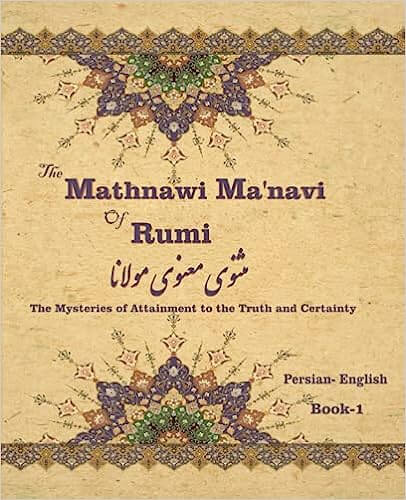
Mathnawi Book One – Rumi’s Masnavi, Persian–English Bilingual Edition — $17.50
Category: Rumi, All Books
Rumi’s Spiritual Couplets, Book One: the complete Persian text with Nicholson’s English translation on facing lines, from the Song of the Reed to the first great cycle of stories.
The complete Rumi guide
Practice posts for learners
- 5 Rumi Persian Pronunciation Drills to Read Faster
- 7 Persian Verb Conjugation Tips from Rumi’s Poetry
- Rumi’s Persian Handwriting: A Heritage Reader’s Guide
- Persian CEFR levels: where you are and what to read next
Frequently asked questions about reading Rumi in Persian
Can I read Rumi in Persian as a beginner?
You can start, but it is easier from about intermediate (B1) level. Learn the script and basic grammar first, then begin with the first eighteen lines of the Masnavi with a literal translation beside you. Many lines use simple, everyday words, so progress comes quickly.
Is Rumi's Persian the same as modern Persian?
Mostly. Rumi wrote 750 years ago, but much of his vocabulary and grammar is still used today, and Iranian readers understand a large part of the Masnavi. You will meet some old spellings, Arabic words and Qur'anic phrases, which a good edition explains.
Where should I start reading the Masnavi?
Start with the Song of the Reed, the first eighteen couplets of Book One. It is short, famous and introduces every key image of the poem. Then read short stories from Book One, such as the Grocer and the Parrot, a few couplets a day.
What is the meter of the Masnavi?
The whole Masnavi uses one meter, ramal: fa'elaton fa'elaton fa'elon. Each half-line follows the pattern long-short-long-long, long-short-long-long, long-short-long. Reading the first couplets aloud until the rhythm feels natural makes every later line easier.
Do I need a bilingual edition?
It helps a great deal. A bilingual Persian–English edition lets you read the original and check every word against a translation on the same page. Persian Bell's six-volume Mathnawi pairs the complete Persian text with Nicholson's English translation.
Key takeaways
- Learn the script and basic grammar, then start with the Song of the Reed.
- Read each couplet aloud to catch the single meter of the Masnavi.
- Check every word against a literal translation and learn twenty key words.
- Read a few couplets a day; move from the reed to the short stories of Book One.
Rumi in Persian is one of the great rewards of learning the language. Begin with fifteen minutes and the first couplet tonight, and keep Mathnawi Book One open beside you, Persian and English on the same page.