📖 Reading time: 11 min
Quick answer: The Divan of Hafez is the collected poetry of Hafez of Shiraz: about 500 ghazals plus a few other poems. The standard Persian edition (Qazvini–Ghani, 1941) has 495 ghazals. In English, read a complete literal version such as Clarke (1891) or Avery (2007), or a bilingual edition with the Persian alongside.
Who this is for: readers choosing their first Divan of Hafez, Persian learners who want a bilingual edition, and anyone confused by the many different “Hafiz” books on sale.
Search for “Divan of Hafez” and you will find dozens of books with almost the same title, different numbers of poems and translations that barely resemble each other. Some are scholarly, some are beautiful, and some are not really Hafez at all.
The Divan of Hafez (دیوان حافظ, Divan-e Hafez, also written Divan-i Hafiz or Diwan) is the book Iranians keep at home, read on Yalda night and open for a Fal. According to Encyclopaedia Iranica, the standard Qazvini–Ghani edition contains 495 ghazals (Iranica, Hafez iii).
This guide explains what the Divan contains, why editions differ, how the main English translations compare, and which Divan of Hafez to choose for reading, studying or giving as a gift.
What is the Divan of Hafez?
A divan is the collected poems of a single poet, and the Divan of Hafez is the collection of everything attributed to Hafez. Almost all of it is ghazals: short lyric poems of rhymed couplets that share one rhyme and usually end with Hafez naming himself.
What the Divan contains
Iranica describes the Divan as mainly ghazals, with a small number of poems in other forms: qasidas (odes), moqatta’at (occasional poems) and masnavis (poems in couplets), including the Saqi-nama, a poem about wine and the cupbearer. It also notes that “serious doubts have been raised” about the authenticity of the quatrains (ruba’is) found in many copies (Iranica, Hafez iii).
How the Divan is ordered
Like most classical Persian divans, the ghazals are arranged by their rhyme, following the order of the alphabet. That is why the very first ghazal of most editions, Ala ya ayyoha-s-saqi, is one whose rhyme ends in alef (navelha, moshkel-ha), and why ghazal numbers jump around in theme rather than following any story.
For the life of the poet and his place in Persian culture, start with our guide to Hafez (Hafiz Shirazi): life, poems and Divan.
Persian editions of the Divan: why the numbers differ
Different editions of the Divan contain different numbers of ghazals because Hafez left no authorized copy, and editors have rebuilt the text from manuscripts copied after his death. Iranica gives these counts for the three best-known modern editions (Iranica, Hafez iii):
| Edition | Year | Ghazals |
|---|---|---|
| Mohammad Qazvini and Qasem Ghani | 1941 (1320 Sh.) | 495 |
| Parviz Natel Khanlari, 2nd edition | 1983 (1362 Sh.) | 486 |
| Hushang Ebtehaj (Saya) | 1993 | 484 |
The Qazvini–Ghani edition is the reference most readers and websites use. The free Persian text on Ganjoor, for example, numbers the ghazals the Qazvini–Ghani way, and so does this series. If a book or article mentions “ghazal 255”, check which edition it follows before comparing.
English translations of the Divan of Hafez compared
The best English translation of the Divan depends on what you want: a complete, literal version for study, or a smaller selection in fine English verse. Here are the landmarks, from Iranica’s survey of English translations (Iranica, Hafez x) and the publishers’ own pages.
| Translator | Year | What it covers | Style | Best for |
|---|---|---|---|---|
| H. Wilberforce Clarke | 1891 | The complete Divan | Very literal prose, with Sufi commentary | Study and checking every word |
| Gertrude Bell | 1897 | Selection | Verse; Iranica calls it “the most lucid, musical and accurate of the verse translations” | Reading for pleasure |
| A. J. Arberry | 1947 | Fifty Poems of Hafiz, with the Persian texts | Scholarly, with notes | Students of Persian |
| Paul Smith | 1983 | Divan of Hafiz | Fits Hafez into English ghazal forms; Iranica is critical of the results | Readers who want English rhyme |
| Elizabeth T. Gray Jr. | 1995 | The Green Sea of Heaven: fifty ghazals | Close, modern verse | A careful modern selection |
| Peter Avery | 2007 | The Collected Lyrics of Hafiz of Shiraz: 486 ghazals (Khanlari’s edition) | “Rendered as literally as possible” | The complete Divan in modern English |
| Dick Davis | 2012 | Faces of Love: Hafez and the Poets of Shiraz (selection) | Verse by a leading scholar; Penguin Classics edition 2014 | The most readable introduction |
Sources: Iranica, Hafez x; Avery: IPG; Davis: Mage Publishers and Penguin.
What about Daniel Ladinsky?
Daniel Ladinsky’s popular books, such as The Gift and I Heard God Laughing, are not translations of the Divan. Ladinsky’s own website says, “My poems are not translations in a literal or scholarly sense” (danielladinsky.com). They are modern poems inspired by Hafez, and you won’t find their lines in the Persian. Our guide to which Hafiz quotes are real explains how to tell the difference.
Which Divan of Hafez should you buy?
Choose by how you plan to read. Here is a simple guide:
- You want to read Hafez in Persian, with help. Choose a bilingual edition with the Persian and a literal English version on facing pages. It lets you check every word without losing the music of the original.
- You want every poem in English. Choose a complete translation: Clarke’s (1891) is the classic complete version, and Avery’s Collected Lyrics (2007) is a complete modern one.
- You want to fall in love with Hafez first. Start with a selection in good English verse, such as Dick Davis’s Faces of Love or Gertrude Bell’s Poems from the Divan of Hafiz, then move to a complete Divan.
- You want it for Fal-e Hafez or Yalda. Choose a complete Divan, ideally bilingual, so every page gives a whole ghazal and everyone at the table can follow it.
- You are buying a gift. A bilingual Divan suits both Persian speakers and their friends; a daily selection suits someone who wants a short poem each morning.
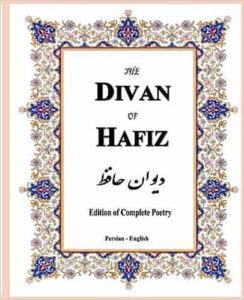
Persian Bell’s own Divan-i Hafiz is a bilingual edition of the complete Divan: the Persian text with H. Wilberforce Clarke’s complete English translation side by side, in one 462-page book. If you would rather read one poem a day, Through the Year with Hafiz gives you a short Hafez poem in Persian and English for each day of the year.
Is there a free Divan of Hafez online?
Yes, for the Persian. The Ganjoor digital library publishes the full Persian text of the Divan, ghazal by ghazal, with the Qazvini–Ghani numbering. Clarke’s 1891 translation is old enough to be out of copyright, so scans of it circulate online as PDFs, though they can be hard to read and do not set the Persian beside the English.
A first look inside the Divan
Open almost any edition of the Divan and the first poem you meet is ghazal 1. Its opening couplet mixes Arabic and Persian and sets the theme of the whole book: love that begins easily and turns hard.
اَلا یا اَیُّهَا السّاقی اَدِرْ کَأسَاً و ناوِلْها
که عشق آسان نمود اوّل ولی افتاد مشکلهاAla ya ayyoha-s-saqi, ader ka’san va navelha / ke eshq asan nemud avval vali oftad moshkel-ha
“O cupbearer, pass the cup around and hand it to me,
for love looked easy at first, but then came the difficulties.”
Notice the rhyme: navelha, moshkel-ha. Every couplet of this ghazal ends in -ha, which is why it sits first in a Divan ordered by rhyme. Now look at how a ghazal ends. This is the last couplet of ghazal 3, where Hafez praises his own poem:
غزل گفتی و دُر سُفتی بیا و خوش بخوان حافظ
که بر نظمِ تو اَفشانَد فَلَک عِقد ثُریّا را“You have made a ghazal and strung pearls; come, Hafez, sing it sweetly,
so that heaven may scatter the necklace of the Pleiades over your verse.”
That signature couplet, with the poet’s pen name (takhallos), is how you can always tell where one ghazal ends and the next begins as you leaf through the Divan. For more poems like these, see our selection of Hafez poems in English, and for a step-by-step method, how to read a Hafez ghazal.
Frequently asked questions about the Divan of Hafez
What is the Divan of Hafez?
The Divan of Hafez is the collected poetry of the 14th-century Persian poet Hafez of Shiraz. It consists mainly of ghazals, short lyric poems of rhymed couplets, along with a few odes, occasional poems and poems in couplets. It is the most widely read book of poetry in Iran and the book used for Fal-e Hafez.
How many ghazals are in the Divan of Hafez?
The Divan of Hafez contains about 500 ghazals, depending on the edition. The standard Qazvini–Ghani edition of 1941 has 495, Khanlari's second edition of 1983 has 486, and Saya's edition has 484, according to Encyclopaedia Iranica. The differences come from how editors judge the old manuscripts.
What is the best English translation of the Divan of Hafez?
For the complete Divan, H. Wilberforce Clarke's 1891 translation and Peter Avery's 2007 Collected Lyrics are the main literal versions. For readable verse, Dick Davis's Faces of Love and Gertrude Bell's 1897 selection are widely admired. For studying Persian, a bilingual edition is the most useful choice.
Is the Divan of Hafez available in Persian and English together?
Yes, bilingual editions set the Persian text beside an English translation. Persian Bell's Divan-i Hafiz, for example, pairs the Persian with Clarke's complete English translation in one volume, which suits learners, heritage readers and families who take a Fal-e Hafez together.
What does divan mean?
Divan (also spelled diwan) means the collected poems of a single poet in Persian, Arabic, Turkish and Urdu literature. The Divan of Hafez is therefore simply the book of Hafez's poems. Do not confuse it with the Divan-e Shams, which is a collection of poems by Rumi.
📚 More from Persian Bell
🎯 Recommended Book
Divan-i Hafiz – Complete Ghazals of Hafez, Persian–English Bilingual Edition — $17.50
Category: Hafez, All Books
The complete Divan of Hafez with the Persian text and H. Wilberforce Clarke’s English translation side by side, in one 462-page edition.
Key takeaways
- The Divan of Hafez is his collected poems, mostly ghazals, arranged by rhyme.
- The standard Qazvini–Ghani edition has 495 ghazals; other editions have 484 to 486.
- Clarke (1891) and Avery (2007) translate the complete Divan; Bell and Davis offer fine selections.
- Ladinsky’s “Hafiz” books are modern poems, not translations.
- For learning and for Fal-e Hafez, a bilingual edition is the most useful Divan.
The right Divan of Hafez is the one you will open again and again. If you want the Persian and the whole Divan in English in one place, start with our Persian–English Divan-i Hafiz, or browse all our Hafez books.
Guides in this series
Sources
- Encyclopaedia Iranica, "Hafez iii. Hafez’s Poetic Art"
- Encyclopaedia Iranica, "Hafez x. Translations of Hafez in English"
- Britannica, "Hafez"
- IPG, The Collected Lyrics of Hafiz of Shiraz (Avery)
- Mage Publishers, Faces of Love (Davis)
- Penguin, Faces of Love
- Daniel Ladinsky, official website
- Ganjoor, Divan of Hafez