📖 Reading time: 13 min
Quick answer: To read a Hafez ghazal, first find its form (the rhyme, the repeated radif and the signature couplet), then read it aloud in Persian to feel the meter, work through a literal translation couplet by couplet, and finally read it again in Persian for its double meanings.
Who this is for: Persian learners at intermediate level and above, heritage speakers who understand Persian but find Hafez hard, and English readers who want to read a bilingual Divan properly.
Reading your first Hafez ghazal in Persian can feel overwhelming: classical vocabulary, Arabic loanwords, and images that seem to mean two things at once. That reaction is normal, and the good news is that every ghazal follows the same few rules.
Hafez left about 500 ghazals, 495 in the standard Qazvini–Ghani edition (Encyclopaedia Iranica), and Britannica describes the ghazal as a lyric of 6 to 15 couplets “linked by unity of subject and symbolism” (Britannica). Once you can see that structure, any ghazal becomes much easier to read.
This guide gives you the vocabulary of the ghazal, a seven-step reading method, a complete worked example (ghazal 8, all nine couplets with a literal translation), and a glossary of the symbols Hafez uses most.
The parts of a Hafez ghazal
Every Hafez ghazal is built from the same parts. Learn these Persian terms and you will be able to describe any poem in the Divan.
| Persian | Term | What it means |
|---|---|---|
| بیت | bayt | A couplet, the basic unit of the ghazal. Each bayt is a complete thought. |
| مصراع | mesra’ | A hemistich, one half of a bayt. Each line on the page is a mesra’. |
| مطلع | matla’ | The opening couplet, in which both halves rhyme. It sets the theme, meter and rhyme. |
| قافیه | qafiye | The rhyme, the sound that repeats before the radif (in ghazal 8: -ām). |
| ردیف | radif | A word or phrase repeated after the rhyme at the end of every couplet (in ghazal 8: rā). |
| وزن | vazn | The meter, a fixed pattern of long and short syllables held through the whole poem. |
| تخلص | takhallos | The pen name. Hafez names himself, usually in the last couplet. |
| مقطع | maqta’ | The closing couplet, which usually contains the takhallos. |
With these terms, the shape of a ghazal is simple: a matla’ that rhymes in both halves, a series of couplets that each end with the same qafiye and radif, and a maqta’ where Hafez speaks to himself by name. For the bigger picture of the Divan, see our guide to the Divan of Hafez.
A seven-step method for reading Hafez
The most reliable way to read Hafez is in layers: structure first, sound second, meaning third, and double meaning last. Give one ghazal a week rather than reading many quickly.
- Map the form before you read. Find the radif and the qafiye by looking at the ends of the couplets, and find the couplet with “Hafez” in it. Knowing where the poem rhymes and ends gives you a frame before the words get difficult.
- Read it aloud in Persian. Even if you understand little at first, read slowly and let the meter carry you. Classical Persian poetry is built for the ear, and the rhythm will help you split words and phrases correctly.
- Work through a literal translation, couplet by couplet. Use a translation that stays close to the Persian, not a free verse version. Match each English phrase to the Persian words, and underline the ones you need to learn.
- Look up the symbols. Words like saqi, mey, zahed and sarv carry centuries of meaning. Check them against the glossary below; often one symbol unlocks a whole couplet.
- Read each couplet as a complete poem. In a ghazal, couplets often stand alone, linked by mood rather than story. Ask what each one says on its own before asking how they connect.
- Read the signature couplet as the key. In the maqta’, Hafez speaks to himself, often with advice or irony. Many readers find that this last couplet turns or sums up the whole poem.
- Return to the Persian and read for double meanings. Now read the poem again in Persian and notice where a word could be read two ways: earthly or divine love, real or symbolic wine. This is where Hafez becomes Hafez.
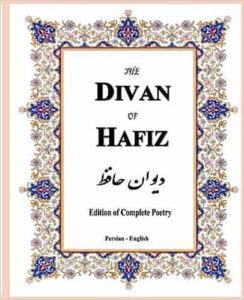
A bilingual edition makes steps 2 to 7 much easier because you never lose your place between the languages. Our Divan-i Hafiz sets the Persian beside Clarke’s complete English translation; if the script is still new to you, start with Persian Alphabet for Beginners.
Worked example: ghazal 8, line by line
Ghazal 8, “Saqiya barkhiz”, is a good first ghazal: nine couplets, short lines, and a clear message. Here is the whole poem with our literal translation. Persian text from Ganjoor.
| # | Persian | Literal English |
|---|---|---|
| 1 | ساقیا برخیز و دَردِه جام را خاک بر سر کن غمِ ایّام را |
Cupbearer, rise and pass round the cup; pour dust on the head of the sorrow of these days. |
| 2 | ساغرِ مِی بر کَفَم نِه تا ز بَر بَرکِشَم این دلقِ اَزرَقفام را |
Put a goblet of wine in my palm, so I can pull this dark-blue dervish cloak off my body. |
| 3 | گرچه بدنامیست نزد عاقلان ما نمیخواهیم ننگ و نام را |
Though the sensible call it disgrace, we care for neither shame nor fame. |
| 4 | باده دَردِه چند از این بادِ غرور خاک بر سر، نفسِ نافرجام را |
Pass the wine! How long this wind of pride? Dust on the head of the ill-fated self. |
| 5 | دودِ آهِ سینهٔ نالانِ من سوخت این افسردگانِ خام را |
The smoke of the sighs from my lamenting breast has burned these cold, unripe ones. |
| 6 | محرمِ رازِ دلِ شیدایِ خود کس نمیبینم ز خاص و عام را |
I see no one, high or low, who could keep the secret of my love-mad heart. |
| 7 | با دلارامی مرا خاطر خوش است کز دلم یک باره بُرد آرام را |
My heart is happy with a heart-soother who took all the peace from my heart at once. |
| 8 | ننگرد دیگر به سرو اندر چمن هرکه دید آن سروِ سیماندام را |
Whoever has seen that silver-limbed cypress will never again look at the cypress in the meadow. |
| 9 | صبر کن حافظ به سختی روز و شب عاقبت روزی بیابی کام را |
Be patient, Hafez, through hardship day and night; in the end, one day, you will find what you desire. |
Step 1: the form
Look at the line ends: jam ra, ayyam ra, azraq-fam ra, nam ra, nafarjam ra, kham ra, ‘am ra, aram ra, andam ra, kam ra. The qafiye is -ām and the radif is rā. Both halves of couplet 1 rhyme, so it is the matla’, and couplet 9 names Hafez, so it is the maqta’.
Step 2: the meter
Ganjoor gives the meter as fā’elāton fā’elāton fā’elon, the ramal meter, and notes that it is the meter of Rumi’s Masnavi. Read sā-qi-yā bar-khī-zo dar-deh jā-m(o) rā aloud and you will hear the pattern: long-short-long-long, twice, then long-short-long.
Step 3: the key symbols
- Saqi (cupbearer) and mey (wine): joy, freedom and, for Sufi readers, divine love.
- Dalq-e azraq-fam, the dark-blue patched cloak of the dervish: outward piety. Hafez wants to throw it off, a classic jab at religious show.
- Nang o nam, “shame and fame”: reputation. The lover no longer cares what people think.
- Sarv, the cypress: the tall, graceful beloved. In couplet 8 the beloved is a “silver-limbed cypress” who outshines every real tree.
Step 4: the wordplay
Couplet 7 is a small masterpiece: Hafez is happy with a del-aram, literally a “heart-soother”, who has taken all the aram, the peace, from his heart. The beloved is both the cause of his peace and its thief.
Step 5: the signature couplet
The maqta’ is the poem’s quiet turn. After the defiance of the earlier couplets, Hafez tells himself: be patient through hardship, and one day you will reach your desire. It is advice many Iranians quote in hard times.
To read more ghazals the same way, try the opening couplets in our collection of Hafez poems in English. If you want to use a ghazal for guidance, our Fal-e Hafez guide shows how Iranians read a ghazal as an answer.
Hafez’s key symbols: a quick glossary
These symbols appear again and again in the Divan. Learn them and half of Hafez opens up.
| Persian | Say it | What it usually stands for |
|---|---|---|
| ساقی | saqi | cupbearer; the one who pours, often a figure of grace |
| می / باده | mey / bade | wine; joy, sincerity, divine love |
| میخانه | meykhane | tavern; a place of honesty, opposed to the hypocrite’s mosque |
| پیر مغان | pir-e moghan | the old tavern-keeper; the true spiritual guide |
| زاهد | zahed | the ascetic; usually the hypocrite of piety |
| رند | rend | the free spirit who breaks convention but stays sincere |
| باد صبا | bad-e saba | the morning breeze; the lovers’ messenger |
| زلف | zolf | the beloved’s tresses; a snare for the heart |
| خال | khal | the beauty mark; a single point of fascination |
| سرو | sarv | the cypress; the tall, graceful beloved |
| گل و بلبل | gol o bolbol | the rose and the nightingale; beloved and lover |
| جام | jam | the cup; also the legendary world-revealing cup of Jamshid |
Frequently asked questions about reading Hafez
Is Hafez hard to read in Persian?
Hafez is challenging but not out of reach. His Persian is six centuries old and full of Arabic words and symbols, yet much of his grammar is close to modern Persian. With a literal translation beside you and one ghazal at a time, intermediate learners can begin reading him within months.
What is a ghazal in Persian poetry?
A ghazal is a short lyric poem of rhymed couplets that share one rhyme and often a repeated end word, the radif. It usually opens with a couplet whose two halves rhyme and closes with the poet's pen name. Hafez is considered the greatest master of the Persian ghazal.
What are radif and qafiye?
The qafiye is the rhyme that repeats at the end of every couplet, and the radif is the word or phrase that follows it each time. In Hafez's ghazal 8, the qafiye is -ām (jām, ayyām, kām) and the radif is rā, so every couplet ends in "-ām rā".
Which Hafez ghazal should a beginner read first?
Start with a short, clear ghazal such as ghazal 8, "Saqiya barkhiz", which has nine couplets in a short meter and ends with the famous advice to be patient. Ghazal 104 and ghazal 255 are also good first choices because their repeated end words make the structure easy to see.
Do I need to know the Persian alphabet to read Hafez?
You can start with transliteration and translation, but the Persian script makes a big difference: it shows the rhyme and the radif at a glance and lets you use any edition of the Divan. Even a basic reading knowledge of the 32-letter Persian alphabet will make Hafez much easier.
📚 More from Persian Bell
🎯 Recommended Book
Divan-i Hafiz – Complete Ghazals of Hafez, Persian–English Bilingual Edition — $17.50
Category: Hafez, All Books
The complete Divan of Hafez with the Persian text and H. Wilberforce Clarke’s English translation side by side, in one 462-page edition.
Key takeaways
- Every ghazal has the same parts: matla’, qafiye, radif, meter, takhallos and maqta’.
- Read in layers: form, sound, literal meaning, symbols, then double meaning.
- Ghazal 8 is an ideal first ghazal: nine short couplets ending in -ām rā, with the advice to be patient.
- A bilingual edition and a glossary of symbols are the two best tools for reading Hafez.
Reading Hafez in Persian is one of the great rewards of learning the language, and it starts with one ghazal. Read ghazal 8 aloud tonight, then continue with a bilingual Divan-i Hafiz beside you.